Now at 63 Years of Age Armstrong Had Done It Again With a Tune Called Hello Dolly

Louis 'Satchmo' Armstrong, the great jazz trumpeter and vocalist playing at the Savoy Hotel, London. Harrison/Getty Images hide caption
toggle explanation
Harrison/Getty Images
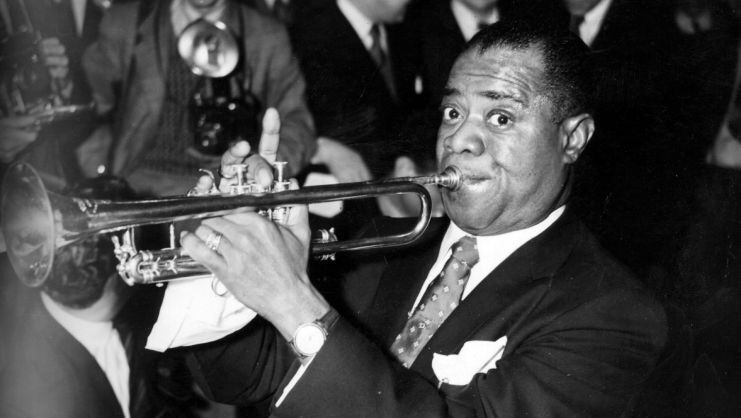
Louis 'Satchmo' Armstrong, the great jazz trumpeter and vocaliser playing at the Savoy Hotel, London.
Harrison/Getty Images
NPR 100 Fact Canvass
Title: Hello, Dolly
Artist: Words/music Jerry Herman
Every bit performed by Louis Armstrong
Reporter: Murray Horwitz
Length: vii:30
Interviewees: Jerry Herman, songwriter
Recordings Used: Hello, Dolly, Louis Armstrong
When you talk to a great person at the end of a career, a medico or a lawyer, a mother or a male parent, or if y'all hear a great coach talk about what it takes to win a championship, they'll say that after all the knowledge and all the skill, what it finally comes downwardly to is character. It's true in music, too. The greatest performances get beyond virtuosity, across music even, to an assertion of humanity. And in 1964 there was a shining musical moment made almost purely by forcefulness of character.
Louis Armstrong had non heard of the musical "Hello, Dolly!" before recording the title tune. It had been brought to him past a music publisher. The song itself is not a specially high achievement. At the recording session in New York, December 4th, 1963, Armstrong expressed no bang-up enthusiasm for it. But the songwriter, Jerry Herman, is a canny Broadway craftsman who knows how to write for stars. He gives corking performers keen opportunities. Just he recently told NPR that fifty-fifty he had his doubts about "Hello, Dolly!"
"When a man from my publishing visitor chosen me and said, `Louis Armstrong wants to record that,' I laughed. I thought it was the silliest idea that I had ever heard. But I said, `Permit him take a skillful time. I'thou delighted,' you know. And when I heard the recording, I fell out of my chair because he turned my 1890's valentine into 1 of the most famous pop songs of all fourth dimension."
How did he practice information technology? The song sounds predictable. In fact, information technology bears such a striking similarity to a 1949 melody by Mack David, "Sunflower," that David sued for plagiarism and got an out-of-court settlement. The treatment of the song is, well, a petty corny. At that place's that banjo. And what's that cord section doing there? Simply as the trumpeter and composer Wynton Marsalis has said, `In everything he ever recorded, there comes a point where Louis Armstrong let you know that he was Louis Armstrong.' On ane level, that bespeak comes correct at the get-go when the maestro sings, "This is Louis, (emphasis on the Southward), Dolly." But for me, the moment is a purely musical one at the end of the first viii measures of his trumpet solo.
Outset of all, it's a terrific solo, difficult-swinging, as Armstrong'south e'er are, but in that location's this footling phrase at the end of the opening. It'south that individual stamp, that celebration of liberty and joy that Armstrong tried to put into everything and it never came out stronger than in "Hello, Dolly!"
Arvell Shaw was Armstrong'southward bassist for over 20 years, including the "Hello, Dolly!" session. He says Armstrong was so unimpressed by the tune he forgot about information technology. Famously, he seldom listened to the radio, preferring the tapes that he carried with him everywhere. In the winter of 1964 in concerts in Iowa and Nebraska, people in the audience began to shout for "Hello, Dolly!" For a few nights, Armstrong ignored them. Finally, he turned to Arvell Shaw ane nighttime and asked, `What'southward "Hello, Dolly!"?' 'Well, you know, Pops, it'south that melody we recorded.'
Armstrong called New York for the sheet music. A rehearsal was held. That nighttime Louis Armstrong and the Allstars played "Hello, Dolly!" and the crowd went wild. By May, the tape had incredibly pushed The Beatles out of the number-one spot on the Billboard top 40 for the first time in over 3 months. And at age 63, Louis Armstrong had become the oldest person ever to have a number-one striking record.
I asked Arvell Shaw, `Why?' He said, `I've been trying to figure that out for 40 years. If somebody could write a volume well-nigh what made "Hello, Dolly!" a hit, they'd make a fortune.' My reply: Louis Armstrong, pure and simple, the force of his personality, his irresistible humanity. Well, Arvell's not entirely sure about that. He thinks it as well had something to do with the timing of a big Broadway striking bear witness and the release of the championship melody past a big star. Merely equally he talked, he agreed, nobody else could have taken that song and made information technology a striking.
Louis Armstrong played for audiences all over the earth; for millions in Africa, Asia, Europe, Latin America and for kids eating ice cream on his front porch in Queens. And everywhere he went, audiences responded to him the same fashion. It used to puzzle me. Musicians have told me, `It's impossible that all those people really understood his music. What they must have responded to was his spirit, his integrity and his life force.' What they understood was Louis.
Source: https://www.npr.org/2000/07/30/1080117/hello-dolly
0 Response to "Now at 63 Years of Age Armstrong Had Done It Again With a Tune Called Hello Dolly"
Post a Comment