Example of Health Care Yearly Annual Review Business Plan
By Sara Allin, Greg Marchildon, and Allie Peckham, N American Observatory on Wellness Systems and Policies, University of Toronto
Canada has a decentralized, universal, publicly funded health system called Canadian Medicare. Health care is funded and administered primarily by the state'due south 13 provinces and territories. Each has its own insurance plan, and each receives cash help from the federal regime on a per-capita footing. Benefits and delivery approaches vary. All citizens and permanent residents, however, receive medically necessary hospital and physician services complimentary at the point of use. To pay for excluded services, including outpatient prescription drugs and dental care, provinces and territories provide some coverage for targeted groups. In add-on, about two-thirds of Canadians have private insurance.
How does universal health coverage work?
Canadian Medicare — Canada'south universal, publicly funded wellness intendance system — was established through federal legislation originally passed in 1957 and in 1966. The Canada Health Human action of 1984 replaces and consolidates the 2 previous acts and sets national standards for medically necessary hospital, diagnostic, and physician services. To be eligible to receive full federal cash contributions for health intendance, each provincial and territorial (P/T) wellness insurance plan needs to comply with the five pillars of the Canada Health Act, which stipulate that it be:
- Publicly administered
- Comprehensive in coverage conditions
- Universal
- Portable across provinces
- Attainable (for example, without user fees).
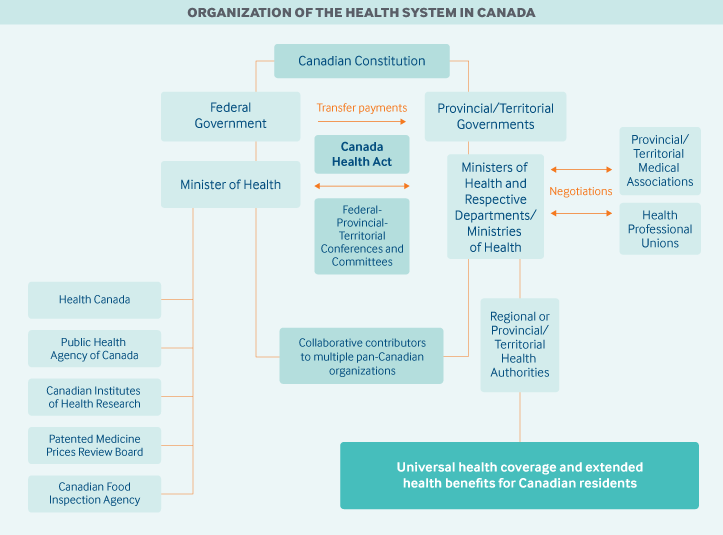
Role of authorities: Canadian P/T governments have principal responsibility for financing, organizing, and delivering health services and supervising providers. The jurisdictions directly fund physicians and drug programs, and contract with delegated health authorities (either a single provincial authority or multiple subprovincial, regional regime) to deliver infirmary, community, and long-term care, also as mental and public health services.
The federal government cofinances P/T universal health insurance programs and administers a range of services for sure populations, including eligible Start Nations and Inuit peoples, members of the Canadian Armed Forces, veterans, resettled refugees and some refugee claimants, and inmates in federal penitentiaries. It also regulates the safety and efficacy of medical devices, pharmaceuticals, and natural health products, funds wellness research and some it systems, and administers several public health functions on a national calibration.
At the national level, a diversity of governmental agencies oversee specific functions:
- Health Canada, which is the federal ministry building of health, plays a primal regulatory role in food and drug condom, medical device and technology review, and the upholding of national standards for universal health coverage.
- The Public Health Agency of Canada is responsible for public wellness, emergency preparedness and response, infectious and chronic disease command and prevention, and health promotion.
- A new federal government section, Indigenous Services Canada, funds sure health services for Offset Nations and Inuit.
Most providers are self-governing under P/T police; they are registered with a provincial regulatory body (such as the College of Physicians and Surgeons) that ensures that didactics, grooming, and quality-of-care standards are met.
About provinces have an ombudsperson who advocates on behalf of patients.
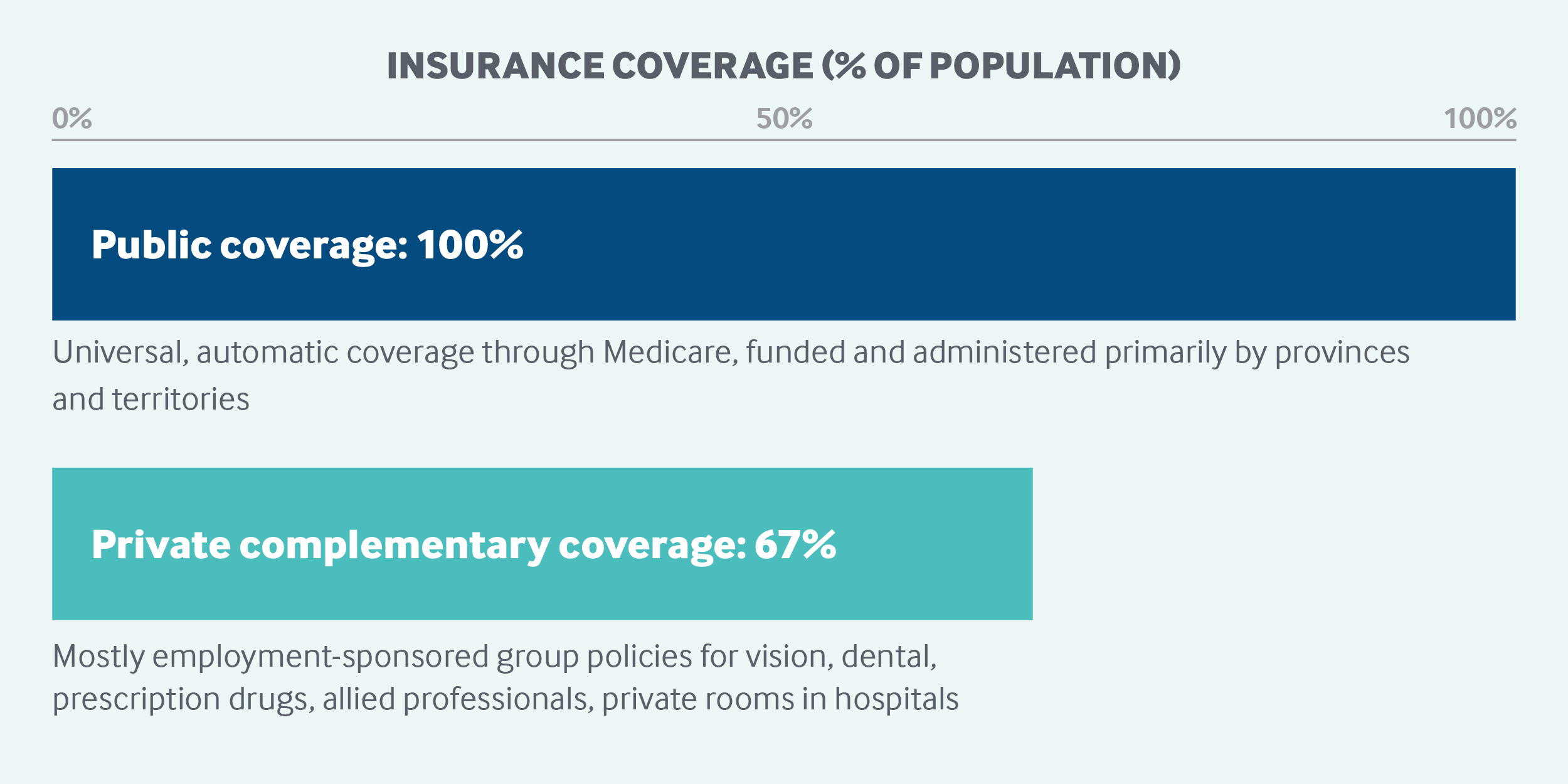
Role of public wellness insurance: Total health spending is estimated to have reached xi.v percent of GDP in 2017; the public sector and private sector deemed for approximately 70 percentage and 30 per centum of full wellness expenditures, respectively.i Each P/T health insurance programme covers all medically necessary hospital and physician services (on a prepaid basis). Supplementary services, or those not covered under Canadian Medicare, are largely privately financed, either from patient out-of-pocket payments or through employer-based or private insurance.
Provinces and territories embrace all of their own residents in accordance with their respective residency requirements.2 Temporary legal visitors, undocumented immigrants, visitors who stay in Canada across the duration of a legal permit, and those who enter the land illegally are not covered by any federal or P/T program. Provinces and territories provide express emergency services to these populations — no doc or hospital tin can turn down to provide care in an emergency, and midwives provide some maternity services.3
The primary funding source is general P/T authorities revenue. Most P/T revenue comes from taxation. About 24 percent (an estimated CAD 37 billion, or USD 29.4 billion, in 2017–2018) is provided by the Canada Health Transfer, the federal program that funds wellness care for provinces and territories.4
Office of private wellness insurance: Private insurance, held by virtually two-thirds of Canadians, covers services excluded under universal health coverage, such every bit vision and dental care, outpatient prescription drugs, rehabilitation services, and individual hospital rooms. In 2015, approximately 90 percent of premiums for individual wellness plans were paid through employers, unions, or other organizations under a grouping contract or uninsured contract (by which a plan sponsor provides benefits to a group outside of an insurance contract). In 2017, private insurance was estimated to account for 12 percent of full wellness spending. 5 The majority of insurers are for-turn a profit.vi
Services covered: To authorize for federal financial contributions, P/T insurance plans must provide first-dollar coverage of medically necessary doc, diagnostic, and hospital services (including inpatient prescription drugs) for all eligible residents. All P/T governments as well provide public health and prevention services (including immunizations) as function of their public programs.
However, there is no nationally divers statutory benefit package; most public coverage decisions are made past P/T governments in conjunction with the medical profession. Because of this, coverage varies across P/T insurance plans for services not federally mandated equally medically necessary, including outpatient prescription drugs, mental health care, vision intendance, dental care, home intendance, midwifery services, medical equipment, and hospice intendance.
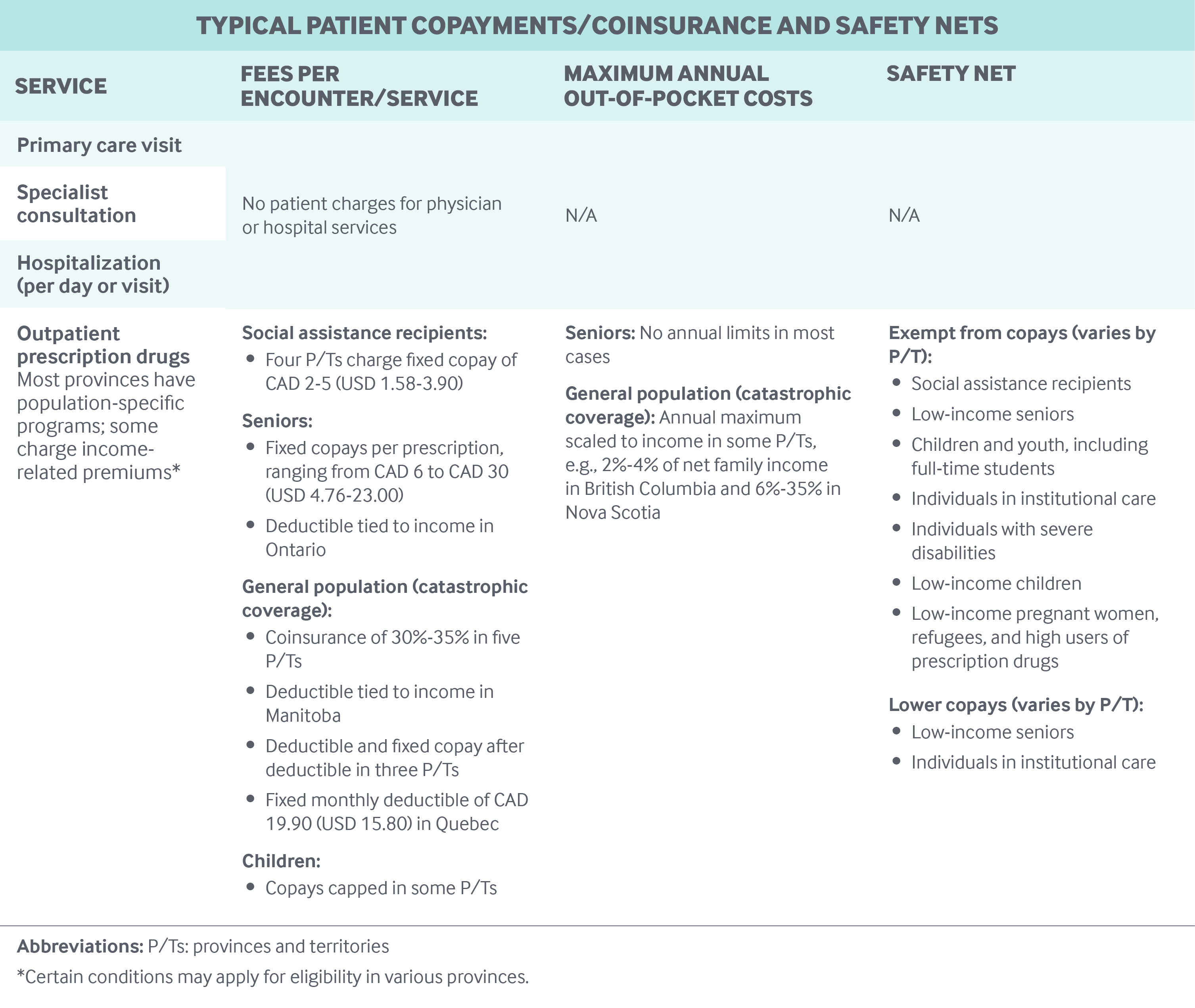
About provinces have public prescription drug coverage programs for specific populations, such every bit recipients of social aid, seniors aged 65 and older, and children and youth. Some programs charge premiums, ofttimes income-related.7
There are some health services that, for the most function, are non covered past whatever P/T insurance plan, including dental services, physiotherapy, psychologist visits, chiropractic care, and corrective or plastic surgery.
Cost-sharing and out-of-pocket spending: There is no cost-sharing for publicly insured dr., diagnostic, and hospital services. Physicians are non immune to charge patients prices above the negotiated fee schedule.
In 2016, out-of-pocket payments were estimated to represent almost 15 percent of full health spending; the bulk was spent on nonhospital institutions (mainly long-term care homes), prescription drugs, dental intendance, and vision intendance.8
Safety nets: To help comprehend needed prescriptions, provinces and territories provide outpatient drug plans to some individuals lacking private employer-sponsored insurance. Most P/T outpatient drug plans operate equally payers of terminal resort, targeting people on social assistance or of retirement historic period. These plans vary considerably. For instance, Quebec administers a universal drug plan by mandating that eligible individuals have private coverage and enrolls those non eligible for individual coverage in the public programme. In contrast, Ontario, Canada'south most populous province, administers a universal prescription drug program for seniors, children and youth without individual coverage, and recipients of social help.
P/T governments also provide some relief for people with loftier out-of-pocket expenses. Subsequently citizens pay more than than 3 percent of their cyberspace income, or CAD ii,288 (USD 1,816), whichever is less, for eligible medical expenses per year, they can receive a 15 percent tax credit for whatever remaining expenses.9
In addition, provinces and territories pay for accommodation and food expenses (beyond nursing care) of indigent individuals in publicly financed long-term care facilities.
How is the delivery organisation organized and how are providers paid?
Physician pedagogy and workforce : Students who obtained a medical degree from ane of Canada'southward 17 public medical schools paid an average annual tuition of CAD 14,780 (USD 11,730) in 2018–2019.ten About 27 percent of Canada's physicians received their degree outside Canada.eleven
In 2017, 92 percent of physicians good in urban locations.12 There are no national programs to ensure a supply of doctors in rural and remote locations. Withal, most provinces have rural do initiatives. For example, Alberta'due south Rural, Remote, Northern Program guarantees physicians an income greater than CAD fifty,000 (USD 39,382).thirteen
Primary care: In 2017, there were two.3 practicing physicians per 1,000 population; about one-half (ane.two per 1,000 population) were family physicians, or general practitioners (GPs), and the rest specialists (i.15 per 1,000 population).14 GPs act largely as gatekeepers, and many provinces pay lower fees to specialists for non-referred consultations.
Almost physicians are self-employed in private practices. In 2014, the last year of the National Md Survey, about 46 percentage of GPs worked in a group practice, 19 percent in an interprofessional practice, and xv pct in a solo practice.15 In several provinces, networks of GPs work together and share resources, with variations across provinces in the composition and size of teams.16
In 2017, about 62 percent of regulated nurses (registered nurses, nurse practitioners, and licensed practical nurses) worked in hospitals and xv percentage in community health settings on salaries.17 In the iii northern territories (Yukon, Northwest Territories, and Nunavut), main intendance is often nurse-led.
In theory, patients have free choice of a GP; in practice, all the same, patients may not be accustomed into a medico's practice if the physician has a closed list. The requirements for patient registration vary considerably past province and territory, merely no jurisdiction has implemented strict rostering.xviii Quebec, through Family Medicine Groups, has used patient enrollment and added (homo and financial) resources to improve access to intendance.
Fee-for-service is the primary course of physician payment, although there has been a movement toward alternative forms of payment, such as capitation. In 2016–2017, fee-for-service payments made upwards about 45 pct of GP payments in Ontario, 72 percent in Quebec, and 82 per centum in British Columbia; capitation and, to a lesser extent, salaries made upwards remaining payments.nineteen
In 2016–2017, the boilerplate clinical payment was CAD 276,761 (USD 219,651) for family medicine, CAD 357,264 (USD 283,543) for medical specialties, and CAD 477,406 (USD 378,894) for surgical specialties.20 In most provinces, specialists have the aforementioned fee schedule as primary intendance physicians.
Provincial ministries of wellness negotiate doctor fee schedules (for primary and specialist intendance) with medical associations. In some provinces, such as British Columbia and Ontario, payment incentives accept been linked to performance.
Outpatient specialist care: Specialists are mostly cocky-employed. There are few formal multispecialty clinics.
The majority of specialist care is provided in hospitals, on both an inpatient and an outpatient ground, although there is a tendency toward providing less-complex services in nonhospital diagnostic or surgical facilities.
Specialists are paid by and large on a fee-for-service basis, although there is variation beyond provinces. For example, in Quebec, alternative payment structures fabricated up about 15 percent of total payments to specialists in 2016–2017, as compared to 22 pct in British Columbia and 33 percent in Saskatchewan.
Patients can cull to go directly to a specialist, but it is more common for GPs to refer patients to specialty care. Specialists who pecker P/T public insurance plans are not permitted to receive payment from privately insured patients for services that would be covered under public insurance.
Administrative mechanisms for direct patient payments to providers: The majority of physicians and specialists bill P/T governments directly, although some are paid a salary past a hospital or facility. Patients may exist required to pay out-of-pocket for services that are not covered past public insurance plans.
After-hours intendance: Afterwards-hours care is frequently provided in physician-led walk-in clinics and hospital emergency rooms. In most provinces and territories, a free telephone service allows citizens to get wellness advice from a registered nurse 24 hours a day.
Historically, GPs take not been required to provide after-hours care, although newer group-exercise arrangements stipulate requirements or financial incentives for providing afterwards-hours care to registered patients.21 In 2015, 48 percent of GPs in Canada (67% in Ontario) reported having arrangements for patients to encounter a doctor or nurse after hours.22 Yet, in 2016, only 34 percent of patients reported having admission to afterward-hours care through their GP.23
Hospitals: Hospitals are a mix of public and private, predominantly not-for-turn a profit, organizations. They are often managed by delegated health authorities or hospital boards representing the community. In almost provinces and territories, many hospitals are publicly owned,24 whereas in Ontario they are predominantly private non-for-profit corporations.25
At that place are no specific data on the number of private for-turn a profit clinics (primarily diagnostic and surgical). Still, a 2017 survey identified 136 private for-profit clinics across Canada.26
Hospitals in Canada generally operate under annual global budgets, negotiated with the provincial ministry building of health or delegated health authority. However, several provinces, including Ontario, Alberta, and British Columbia, have considered introducing activity-based funding for hospitals, paying a fixed amount for some services provided to patients.27
Hospital-based physicians by and large are not infirmary employees and are paid fee-for-service directly by the provincial ministries of health.
Mental wellness care: Physician-provided mental wellness care is covered nether Canadian Medicare, in improver to a fragmented organisation of allied services. Infirmary-based mental wellness care is provided in specialty psychiatric hospitals and in general hospitals with mental health beds. The P/T governments all provide a range of community mental health and addiction services, including example management, help for families and caregivers, community-based crunch services, and supportive housing.28
Private psychologists are paid out-of-pocket or through private insurance. Psychologists who work in publicly funded organizations receive a salary.
Mental health has not been formally integrated into master care. All the same, some organizations and provinces have launched efforts to coordinate or collocate mental health services with principal care. For instance, in Ontario, an intersectoral mental health strategy has been in place since 2011 and was expanded in 2014 to ameliorate integrate mental health and chief care.29
Long-term care and social supports: Long-term care and end-of-life care provided in nonhospital facilities and in the community are not considered insured services under the Canada Health Human action. All P/T governments fund such services through full general tax, but coverage varies beyond jurisdictions. All provinces provide some residential intendance and some combination of example management and nursing care for home care clients, but there is considerable variation when it comes to other services, including medical equipment, supplies, and home support. Many jurisdictions require copayments.
Eligibility for home and residential long-term care services is generally adamant via a needs cess based on health status and functional damage. Some jurisdictions also include means-testing. About one-half of P/T governments provide some habitation care without means-testing, but access may depend both on assessed priority and on the availability of services inside capped budgets.30
The authorities funds personal and nursing care in residential long-term facilities. In addition, financial supplements based on ability to pay tin help support room-and-board costs. Some provinces have established minimum residency periods as an eligibility condition for facility admission.
Spending on nonhospital institutions, most of which are residential long-term intendance facilities, was estimated to account for just over 11 percent of full health expenditures in 2017, with financing mostly from public sources (70%).31 A roughly equal mix of private for-profit, individual nonprofit, and public facilities provide facility-based long-term intendance.
Public funding of domicile care is provided either through P/T authorities contracts with agencies that deliver services or through regime stipends to patients to purchase their own services. For instance, British Columbia'southward Support for Independent Living programme allows clients to buy their own dwelling-support services.32
Provinces and territories are responsible for delivering palliative and terminate-of-life care in hospitals (covered under Canadian Medicare), where the majority of such costs occur. But many provide some coverage for services outside those settings, such as doc and nursing services and drug coverage in hospices, in nursing facilities, and at dwelling house.
In June 2016, the federal government introduced legislation that amended the criminal code to permit eligible adults to request medical assistance in dying from a physician or nurse practitioner. Since that time, P/T governments and medical associations have prepare processes and regulatory frameworks to let for medical assistance in dying for individuals facing terminal or irreversible illnesses.
More than 8 1000000 Canadians are estimated to have provided unpaid support to persons living with chronic health and social needs in 2012.33 Support for informal caregivers (estimated to provide 66% to 84% of care to the elderly) varies by province and territory.34 For example, Nova Scotia'due south Caregiver Benefit Program offers eligible caregivers and care recipients CAD 400 (USD 317) per calendar month.35 In that location are also some federal programs, including the Canada Caregiver Credit and the Employment Insurance Empathetic Care Benefit.
What are the major strategies to ensure quality of care?
Many provinces have agencies responsible for producing health intendance system reports and for monitoring arrangement performance. In addition, the Canadian Constitute for Health Information produces regular public reports on health organisation performance, including indicators of hospital and long-term intendance facility performance. To date, there is no information publicly bachelor on doctors' operation across the state. Virtually provinces mail summary inspection reports online.
Domicile care agencies do not accept reporting standards similar to those for residential long-term intendance. The Canadian Found for Health Information has the Domicile Care Reporting Organisation, which contains demographic, clinical, functional, and resources utilization data for clients served by publicly funded programs across Canada. Even so, in 2018, only 8 jurisdictions were submitting data.36
The use of financial incentives to meliorate quality is limited. At the physician level, they have had, to date, little demonstrable effect on quality.37 Professional revalidation requirements for physicians, including those for standing education and peer review, vary across provinces.
A diversity of other quality initiatives are in progress:
- The federally funded Canadian Patient Safety Constitute promotes best practices and develops strategies, standards, and tools.
- Provincial quality councils facilitate process improvements to produce higher-quality health care.
- The Optimal Use Projects programme, operated by the Canadian Bureau for Drugs and Technologies in Health, provides recommendations (though not formal clinical guidelines) to providers and consumers to encourage the appropriate prescribing, purchasing, and use of medications.
- The federally funded Canadian Foundation for Healthcare Improvement works with P/T governments to implement performance improvement initiatives.
- Accreditation Canada — a nongovernmental organization — provides voluntary accreditation services to about 1,200 wellness intendance organizations across Canada, including regional wellness authorities, hospitals, long-term intendance facilities, and customs organizations.
- Provincial cancer registries feed data to the Canadian Cancer Registry, a national authoritative survey that tracks cancer incidence.
- There is no national patient survey, although a standardized acute-care infirmary inpatient survey developed by the Canadian Institute for Wellness Information has been implemented in several provinces. Each province has its own strategies and programs to address chronic disease.
- The P/T premiers, or prime ministers, established the Wellness Care Innovation Piece of work Group in 2012 to improve quality past, for instance, promoting guidelines for treating eye affliction and diabetes and reducing costs.
What is beingness done to reduce disparities?
The Public Health Agency of Canada includes health disparities reporting in its mandate, and the Canadian Establish for Health Information as well reports on disparities in wellness intendance and health outcomes, with a focus on lower-income Canadians.38 No formal or periodic process exists to measure disparities; even so, several P/T governments take departments and agencies devoted to addressing population wellness and health inequities.
Health disparities between indigenous and nonindigenous Canadians are a business for government at both the federal and the P/T level. The 2018 federal budget offers new funding of CAD 5 billion (USD iii.9 billion) for indigenous people, building on previous investments totaling CAD 11.8 billion (USD ix.3 billion). The money is earmarked for didactics, the environment (for example, water quality), and wellness and social services.39
In 2015, the Truth and Reconciliation Commission, which was established to collect stories regarding the events and effects of the Indian Residential Schoolhouse legacy, released a serial of calls to activity, including several addressing wellness disparities that affect indigenous communities.xl
In Ontario, a strategy to better the health of indigenous people was launched in 2016, with emphasis on investments in primary care, cultural competency training for health intendance providers, access to fresh fruit and vegetables, and mental health services for Commencement Nations youth.41
What is being washed to promote commitment system integration and intendance coordination?
Provinces and territories have introduced several initiatives to improve the integration and coordination of care for chronically ill patients with complex needs. These include Divisions of Family Practice (British Columbia), Family Medicine Groups (Quebec), the Regulated Wellness Professions Network (Nova Scotia), and Health Links (Ontario).
In improver, Ontario has long-standing community-based and multidisciplinary primary care models in place, including Customs Health Centres and Aboriginal Health Admission Centres. Ontario besides continues to expand a pilot program that bundles payments across different providers. This alternative payment arroyo is expected to improve care coordination for patients equally they transition from hospital to the community.42
What is the status of electronic health records?
Uptake of health information technologies has been slowly increasing in recent years. Provinces and territories are responsible for developing their ain electronic information systems, with national funding and support through Canada Health Infoway. However, in that location is no national strategy for implementing electronic health records and no national patient identifier.
Co-ordinate to Canada Health Infoway, provinces have systems for collecting data electronically for the bulk of their populations; however, interoperability is limited. In 2017, 85 pct of GPs reported using electronic medical records, but patients have express access to their own electronic wellness data.43
How are costs independent?
Costs are controlled principally through single-payer purchasing, and increases in existent spending mainly reflect government investment decisions or budgetary overruns. Cost-command measures include:
- Mandatory global budgets for hospitals and regional health authorities
- Negotiated fee schedules for providers
- Drug formularies for provincial drug plans
- Resource restrictions for physicians and nurses (such as provincial quotas for students admitted annually)
- Restrictions on new investment in capital letter and technology.
The Canadian Bureau for Drugs and Technologies in Wellness oversees the national health applied science assessment process, which is one mechanism for containing new engineering costs. This agency produces information about t clinical effectiveness, toll-effectiveness, and broader impact of drugs, medical technologies, and health systems. The agency'due south Common Drug Review assesses the clinical effectiveness and cost-effectiveness of drugs and provides common, nonbinding formulary recommendations to the publicly funded provincial drug plans (except in Quebec) to support greater consistency in admission and evidence-based resources resource allotment.
The federal Patented Medicine Prices Review Lath, an independent, quasi-judicial body, regulates the introductory prices of new patented medications. The board regulates factory gate prices simply does not accept jurisdiction over wholesale or pharmacy prices, or over pharmacists' professional fees.
Since 2010, the Pan-Canadian Pharmaceutical Alliance has negotiated lower prices for 95 brand-proper noun medications and has gear up price limits at 18 percent of equivalent brand-name drug prices for the 15 most common generics.44 Withal this pan-Canadian collaboration, jurisdiction over prices of generics and control over pricing and purchasing nether public drug plans (and, in some cases, pricing nether private plans) are held by provinces, leading to some interprovincial variation.
In addition, the Choosing Wisely Canada entrada provides recommendations to governments, providers, and the public on reducing low-value care.45
What major innovations and reforms have recently been introduced?
As noted above, prescription drugs, outside of hospitals, are non universally covered. At the federal level, there are signs of renewed interest in a pan-Canadian system of drug coverage. In 2018, the Advisory Quango on the Implementation of National Pharmacare was established, and an interim report was produced in 2019.46 If a national program moves forwards, it will be the biggest expansion of public funding and coverage since Canadian Medicare was introduced.
Provinces and territories continue to implement structural reforms to ameliorate efficiency. The latest example occurred in 2017 when Saskatchewan replaced its 12 regional wellness government with a single provincial wellness authorisation. This initiative reflects a national trend toward greater authoritative centralization. Similarly, as part of an evolving reform try, Manitoba established a unmarried provincial organisation — Shared Health — to centralize some clinical and administrative services. In 2019, the Ontario regime announced its plans to consolidate several provincial arm'due south-length agencies, along with the 14 subprovincial wellness regime — Local Health Integration Networks — that administer and deliver health care for their local populations, into a single provincial bureau.47
Source: https://www.commonwealthfund.org/international-health-policy-center/countries/canada
0 Response to "Example of Health Care Yearly Annual Review Business Plan"
Post a Comment